Saturday, July 25, 2020

On Discovering Dance Teaching as an Art Form


Photograph by Adriana Porras
 with Mariana Solano, ballerina.
Both my ballet students, from a photo session in the studio with me.


Discovering Dance Teaching as an Art Form

I had been teaching dance for years systematically and mechanically and until a series of experiences would shake this practice at the very core.  I started an intellectual and practical exploration and I discovered that teaching dance was, unquestionably, art.


I had been distracted at first with class structure and methodology.  I think most dance teachers are.  I was absolutely obsessed with correcting technical imperfections. 


Lost in the challenge of dance proficiency, of liberating from error.


Then a moment of perfect artistry and inspiration happened in my classroom.  I saw it flicker in my students' eyes.  Dancers suspended in beauty and time forever.  The spell broken, the struggle and hard work return, yet the dancer forever changed- the human vulnerable but louder and stronger.


Another day, it happened again.  As Picasso would have described in his own words, the inspiration was real and found us working.  Through reflection I discovered that the moment of artistic explosion had been created by a delicate sequence of stimulating exercises, sensations, patterns, and experiences.  A perfect connection between mental exploration and the embodiment of dance artistry.


I started working harder.  I started diving deeper and began creating a dance class based on experiential learning beyond teacher direction.  The dance and exercises in a structured sequence lead the dance student to work on technique delicately woven into artistic experimentation.  Time created for class sections incorporated and repeated.  And repeated.


The class carefully crafted and the dance technique a vehicle for exploration in itself.  The physical rigour when worked on through careful timing and understanding leads to a meditative state of higher cognitive awareness.  True learning through discovery, feeling and physical challenges... And through this process I now see my dancers become.  I become witness to an artistry and dancing evolve beyond my own as my students colour and texture their learning to a unique voice and expression.


I stand forever changed.  I stand overwhelmed with a feeling of connection, of heightened awareness, of grandeur and smallness, and trembling sensitivity that only inspiration confers.  I stand humbled.  An artist discovering a new vehicle and challenge to my creativity.  A dance teacher discovering, exploring, transforming the mundane work of the class into dance art.   


Saturday, July 18, 2020

Of a New Dream, Of Dance Renewed


@julieballet25

Aspiring Ballerina Julianna Solano in ballet class 

Recently a beautiful, young and aspiring ballerina has joined as a new student of mine.

It was promptly evident that this student has bigger dreams than most, dreams of joining the professional world of dance as a dancer and teaching artist.  Such a life project of hers fills me with hope and joy as another dancer dares to dream big.

I have lately been thinking of the things I want to communicate to my student as she transforms into the artist she seeks to become.  Some seemed so important that I thought it would be better to write them down.  Here are those thoughts, transformed into a letter.


Dear Julianna,

Thank you for including me as part of your adventure as your dance teacher, I confess I will learn much from this process too.

These are my guiding thoughts to share with you as we move forward. 


Dance as if you were never to be able to dance again. 

Be grateful for every step, every breath, every dance.


Be grateful to your body.

Beauty comes from a place of love.


Be humble to learn,

But grand in your dance.


Own your space

Fill it with the greatness of your spirit

Honour the vitality of your soul.


Be brave,

Be bold,

Be unapologetic.


Be powerful as a great Olympian

And delicate and sensitive as the youngest child.


Listen to the critics

In their criticism you will find the key to your growth.

But be deaf to those that predict your failure,

They are not God, they do not know.


Ignore the snobs,

Be patient with the ignorant

To dance is to be forever vulnerable.


Make everything an opportunity for learning.

Nothing is ever a failure,

Unless you quit, unless you stop dancing. 

Only then would you fail, and only then.


The most successful dancer is the most resilient.

Whatever life did not give you as a gift in talent,

You can develop and enjoy as a gift from hard work.


Find your beauty.

Do not be afraid to feel.

Own the moment.


Find the stillness in the movement.

Quiet in music

Peace in the challenge of battle.


Find your voice

Discover your pathway

Love yourself with all your imperfections

Celebrate life, love and dance in every single moment.


No matter how old you become

And how much gray comes to replace your youth…

Do not ever stop dancing

Dance in the living room

             In the kitchen

             In the hall

             In the garden under the sun and the open sky


Be strong Julianna,

May you always find the Song and Joy of your Dance.


Julianna Solano, aspiring ballerina      

@julieballet25 


Thursday, November 21, 2019

On Finding My Voice

On Sunday we had a lovely class discussion at our Middlesex University London evening class.  It was on the topic of finding one’s voice of communication.  The discussion was slow and thoughtful, a metaphor to us finding our voices within the group...
I have found that to find my voice, I must first find my silence...
In my silence, I must start writing...

When writing I must find calmness and allow myself the time to write more...

Some ideas would begin to bloom... but I needed to be calm enough and quiet enough to hear these ideas in my head...

Giving myself time to write and allowing myself to write for exploration without judging the quality...

In my journal my entire inquiry and answers to my research where already written, it just took time and silence to let myself hear them...

My voice has always been here, but muted by excessive activities and meaningless distractions.  Finding my voice is about giving myself my time and my space in the world.  It is about the unimportant moments, the resting time in between structured activities, thinking and sipping coffee...
It is about patience, calmness, discipline, art, creativity, humility and the most powerful silence.

Wednesday, November 6, 2019

Our Afro-Caribbean Dance and Soul


Claudio Taylor and Costa Rican Children's Folklore Ballet 
(Ballet Folklórico Infantil de Costa Rica) 

This is the story of how one single dancer can assume leadership and motivate an entire community with pride and dance.  Through dance an embodied tribute to all that is good of the cultural inheritance is manifested and through which  the roots and richness of Afro-Caribbean Costa Rican dance come back to life.  The heart of Africa pounds through the drums and evolve into a unique Costa Rican choreography and dance capturing the universality of our world voice and humanity, and interpreted through the uniqueness of our national experience and life.  The heart of Africa pounds through the drums and evolve into a unique Costa Rican choreography and dance capturing the universality of our world voice and humanity, and interpreted through the uniqueness of our national experience and life.  In our participation in African dance through our Costa Rican interpretation, we become part of our longest dance started years ago in the first and forgotten original human tribe.  

By inviting us to dance in a class of Afro-Caribbean dance at Taller Nacional de Danza in Costa Rica, Claudio Taylor is inviting us to a life celebration and a process of self-discovery and national healing.  His dance is collective, powerful pounding rhythm and dance into the floor...and yet, with a softness to the hips and a flow of the arms invoking the beauty, peace and fluidity of our Caribbean Sea. 

I first met Claudio in a classical ballet classroom in the Danza Libre studio, in the capital province of Costa Rica.  We were both to dance in the Nutcracker, and he would shortly interpret one of my favourite interpretations of the iconic Rat King.  Claudio is an accomplished dancer with extraordinary refined, long lines and strongest centre.  He is a mature and yet ageless dancer with great many years of dance training and dance exploration.

Afro-Caribbean Costa Rican dance was born in Limon, a seaside province.  During the construction of the railroad Jamaican, Antillian, Chinese and European immigrants arrived to Costa Rica to work.  Although these immigrants were not slaves, bad work conditions, poor wages and deplorable treatment a slave-like life of poverty and discrimination for many years.  Racial discrimination, poverty and geographical distance from the capital city and the Greater Metropolitan Area, led to a cultural divide and insolation that still echos today.


Far from the capital, the strong Afro-Caribbean roots and culture of Limon’s mixed heritage permeated their lifestyle, culinary arts, dress, music and ofcourse, dance.

In an earlier interview Claudio spoke of dance and of his vision and the perception of Afro-Caribbean dance in Costa Rica:

“I would like that Afro-Caribbean dance reach the entire country, that people would realise that Afro-Caribbean culture is not something remote from the rest of Costa Rica, it is something that belongs to us, because we have Limón and the Caribbean Sea, we have the Afro-Costa Rican Caribbean, and by saying this we make an affirmation of belonging to all our people because it is Costa Rican heritage that has nothing to do with skin colour, it is part of our national culture.  Through the processes of globalisation we have to realise that it is a culture that belongs to us and belongs to us all; black, white and indigenous, because we carry it within ourselves.” (2008)

Observing Afro-Caribbean dance class imparted by Claudio himself, the importance of a stable, strong centre, the use of breath, the grounding of hips in a natural sway responding to the bending of the knees.  The arms are strong and fluid.  At times, arm movements used to represent historical narrative such as the symbolic representation of picking bananas from the old plantations.  The rhythmic intensity is hard on the body, with little rest as one sequence feeds into another with greater speed and intricacy...all lead to a stable and strengthening dance technique.


Analysing the value of Afro-Caribbean dance in the early childhood classroom, great benefit can be found for the developing child.  Afro-Caribbean dance uses a great deal of symmetrical work from left to right, and right to left.   Great benefit can be reaped by working on laterality and developing midlines.  The rhythmical patterns and sequential work of Afro-Caribbean choreography allows working in patterns and sequencing which favour logic-mathematical skill development.  The deep plié and strong centre is important for the development of proper strength for fine motor skills conducive to writing.

Beyond the physical skills that children can work on, the most important aspect of working on Afro-Caribbean dance in the classroom is of cultural enrichment.  The developing of a broader understanding of Costa Rican folklore, a folklore that goes beyond our colonial-european roots and embraces our true multicultural heritage that includes our mixed-racial story informed by immigration.  It includes smaller groups than dominant capitol city culture.  It is a true national identity that includes a voice filled of strength, rhythm and Afro-Caribbean dance and soul.


Aquí la gente cuando camina baila...


About Claudio Taylor...

Claudio Taylor began his dance and theatre life at the age of sixteen.  He initially studied in the Limonese Youth Centre for Formation and Recreation.  Claudio attributes his dance formation to Jose Masis, a former dancer of San Francisco Ballet and the Costa Rican National Dance Company.  Claudio's dance specialties are Afro-Caribbean and Contemporary Dance.  He also works in dance research, education and artistic direction of dance.  He has worked with numerous dance companies and toured nationally and internationally.  He works with a fusion of dance styles and genres producing a prolific body of work of more than sixty dance pieces.  His contributions to the Costa Rican effort for the preservation and diffusion of Afro-Caribbean dance are immesurable.


Thursday, October 24, 2019

Costa Rican Folklore Dance and Early Childhood Education


Costa Rican Folklore
Folklore and Creative Movement Dance Teacher 
Valeria Chavarria during her formative years.  


As a dance and early childhood educator, the importance of Costa Rican folklore dance as a formative part of the child’s experience is undeniable from both research and field observation perspectives.

From a dance education perspective, for the Costa Rican child in the early years, folklore dance is an important part of an embodied education rendering national and cultural experience since early childhood.

Through the rite of passage of dressing in typical attire, dancing to folklore music, and following traditional choreography, the Costa Rican child steps into the dancing feet of generations of Costa Ricans who danced before . Through the dance experience, Costa Rican children capture their shared historic identity.

From a socio-affective perspective, Costa Rican dance offers a collective and enthusiastic experience through the guttural awakening of musical passion shared in a group dance.

Furthermore, in moments of national unrest, democratic questioning of identity and patriotic crisis, as will exist in contemporary and future history: folklore dance allows a common, peaceful search of this common identity found in the silence of the dancer in the rhythmic nature of collective dance. Costa Rican children that dance together will find further social interactions less challenging and more natural. Costa Rican folklore dance is danced in groups, and usually paired up with a dance partner.

From a developmental experience for preschool children, the complexity of the gross motor experience is extraordinary. The chorographic patterns of folklore dance organise its dancers in geometric patterns such as circles, diagonals and lines.  Dancers will dance side by side and at times will mirror each other. The nature of such movement leads to great challenges to children in the early years that are working on development of laterality, maturity of their vestibular system, and proprioception (Connell and McCarthy, 2014).  Folklore dance choreography through its patterns and movement, provide experiences that allow the brain to explore such challenges through the body.  Through the physical challenges of Costa Rican folklore dance, early years students will explore body and spatial awareness, developing a sense of body subconscious.


Costa Rican Preschool Amazonas Typical Dance.  
Jethro Desanti in his early childhood.  Dancing in pairs.

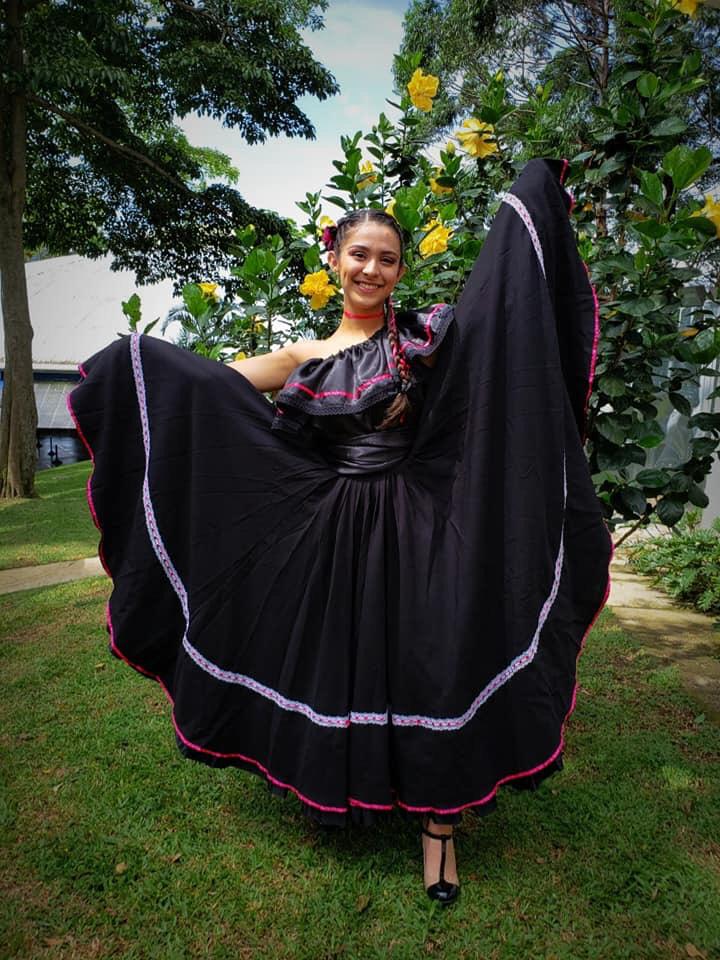
From a historic perspective, Costa Rican folklore dance reunites national mixed cultural heritage.  Appreciating folklore dance at national patriotic celebrations, the audience will see a variety of female dancers with a variety of colourful dresses with flower and lace depending on the province represented, and gentlemen with hats or countrymen attire for the male dancers.

Folklore Dancer and Dance Teacher Valeria Chavarria

Folklore Dancer and Dance Teacher 
Valeria Chavarria


Male campesino typical dress.
Jethro Desanti Preschool years


Folklore dance is lively and light on the dancer’s feet.  Dancing on a low demi point, on the balls of the feet or flat footed, wearing sandals or leather shoes.  Long necks and strong backs characterize a fluid and soft dance.  The music represents different cultural and historic moments, musical groups from pre-colonial, colonial and mixed-immigrant heritage.    The instruments range from the marimba to the guitar, often accompanied with singing to the folkloric dance (Molina and Palmer, 2011). 

Folklore dance teacher Valeria Chavarria is a young dancer and dance teacher of folklore and creative movement dance for preschool and elementary school children in both public and private schools in Costa Rica.  With eleven years’ experience in folklore dance, she was a great participant for this research study and was generous to lend her time for an interview.  Valeria was a folklore dancer for the troupe Batsú Folkloric Projection.  She represented Costa Rican folklore dance both nationally and internationally.  


Folklore Dancer and Dance Teacher 
Valeria Chavarria and Dancer Dylan Alvarado Fernandez

From her international dance experience, she analyses that contemplating the work of international dance troupes, some countries held their folklore dance to extraordinary high esteem.  She further questioned, “why not us?”

Valeria further explained, “the richness of folklore dance escapes most Costa Ricans, the details of dance style, clothing garments and musical interpretation vary greatly from one province to another.  There is so much to learn still.”

Demonstrating such diverse complexity:

Costa Rican Folklore
Folklore and Creative Movement Dance Teacher 
Valeria Chavarria during her formative years.  


Costa Rican Folklore
Folklore and Creative Movement Dance Teacher 
Valeria Chavarria during her formative years.  


 Costa Rican Folklore
Folklore and Creative Movement Dance Teacher 
Valeria Chavarria during her formative years.
  

 Costa Rican Indigineous Folklore
Folklore and Creative Movement Dance Teacher 
Valeria Chavarria during her formative years


Regarding cultural identity and national pride, she insisted once again, “Why is it that in Costa Rica we are not proud as dancers are in other countries of their folklore?”  Her pedagogical vision is of extending and democratising the dance experience for all students.  Thus, allowing the student to gain further cultural appreciation and hands on learning into their own dance traditions and complex national identity.

Valeria suspects that our identity as a developing nation and former Spanish colony weakens our self-image as a nation as we yearn for the commodities and stability of modern, globalised society.  Perhaps she is right, in our quest to seek to progress and become citizens of the world we may forget to look back and understand our roots and cultural grounding.  

Yet perhaps, as Valeria believes, greater exposure and experience of Costa Rican dance in all its richness and complexity could lead to prouder Costa Ricans.  Costa Ricans with greater sensitivity of the cultural complexity that informs our history and shapes our modernity.  

Rethinking Valeria’s words and appreciating the great pride of the international community for folklore, and of the need for cultural awareness and uniqueness in an increasingly homogeneous international community as nations struggle to conform but at the same time seek nationalism, one wonders indeed: Why not us?  Why not greater folklore dance education in our Costa Rican preschools and schools?  Why not, indeed?


             About Valeria Chavarria
                                                                Folklore Dancer and Dance Teacher 

 During my school years, I was part of a group of typical Costa Rican Folklore called Batsù Folkloric Projection. Over the years I also trained in Ballet, Jazz, Hip Hop, Latin Rhythms and Ballroom.
I have attended several national and international art festivals such as the “Festicers Les Enfants du Monde” in France and the FEA in Costa Rica, also dance competitions, congresses and presentations in various theatres in our country.
My goal is to bring art to as many children and young people as possible, teach them that through music and dance people can acquire discipline and motivation; they can express different feelings and above all, show them that they can, in a physical and mental way, develop many skills. It would be a tool from which they can balance their lives and find a way to cope with difficult situations.
-Valeria 


Sunday, October 20, 2019

Alicia Alonso


Alicia Alonso


Prima Ballerina Assoluta Alicia Alonso and founder of the National Ballet of Cuba and the Cuban School of Ballet died on October 17, 2019 at the age of 98. Virtuoso female dancer like no one before her. In an art dominated by the delicate and ethereal woman, she challenged the image of the female gender in classical ballet presenting a strong, athletic, passionate woman with great stage presence. 


Back in her prime, she awakened great admiration from the audiences of the Metropolitan Theatre in New York as few dancers did, and never had a Latina before her, a Cuban.

She could have stayed abroad in New York, in the glory of a dancer with such recognition ... but she decided to return to Cuba.

In a world where women are silent muses and men are the directors, choreographers and absolute leaders Alicia Alonso challenged the classical world again: she became the founder, director, choreographer and teacher of her school and company: The School of Cuban Ballet and the National Ballet of Cuba.

My ballet teacher during my years of study in Mexico, one the company's first-generation soloists and Cuban ballet teacher, Raúl Bustamante, told me that Alicia found her first dancers wherever she found talent regardless of their situation or social status.

She took young men out of the reformatory and told them to use that their energy for good. She was hard on them, demanding unwavering discipline. She helped them find themselves, to become fighters, adult men, dancers.  The Cuban School of Ballet has given the world a spectacular collection of first-class technical and artistic ballet dancers.  In Cuba she challenged machismo and aroused the artistic sensibility of an entire people: the male dancer in Cuba is admired as a national emblem.

Carlos Acosta from the Cuban Ballet Legacy


The scope of The Cuban School of Ballet, the legacy of Alicia Alonso has already become immeasurable. Their male dancers, ballerinas and teachers have sown so many seeds worldwide that the world of dance simply recognizes them and claims them as their own.

All ballet dancers of the world owe part of our artistry to the Great Cuban heritage. Especially in Latin American countries, as in Costa Rica.


I met Alicia Alonso in 1992, I was a very young ballet student. I was impressed to see an elderly adult dancing like her. Her visual disability was significant, she was greatly assisted so as to get her bearings. At that time in the nineties there was no talk of physical disabilities openly, especially in the dance world.  Also the stereotype was that elderly adults were considered people who had to retire and rest, age perceived as a disability as well.

In a rehearsal I observed, her daughter Laura Alonso was directing the rehearsal and coaching her. Laura was very hard on her mother during the rehearsal, she scolded her harshly, as she did not scold anyone. I understood then that professional ballet, like life, was hard and challenges of all types including disabilities, age, gender among others could present great obstacles, even for Alicia Alonso.  Dancing for her, as for all dancers, was challenging too.  Yet she danced.  The humanity and vulnerability of Alicia Alonso was what impressed me the most in my youth.

I want to remember her great like that, as an example of a well lived life, of being a dancer, of being a teacher, but above all as great example of being a wonderful, beautiful, strong and vulnerable, human being.


Thank you, Alicia, may you rest in peace.

Homage to Alicia

The Cuban School of Ballet

Saturday, October 12, 2019

On the Transformative Process of Becoming a Ballerina

Costa Rican Ballerina, Valeria Arias in our first 
Choreographic and Artistic Collaboration together, 
Teatro de La Danza, War Survivors. Body Motion.

Oftentimes as a dancer teacher I have felt that my students come to dance class seeking a profound transformation to become ballerinas.  The students seek the proverbial transformation from ugly duckling into the dancing swan. The artistic metamorphosis to become the butterfly.  They want to become the dancer.

Yet however this approach to dance training and education is conceptually and philosophically flawed: 

The student dancer does not dance to become a ballerina.
Rather, the student dancer dances to discover 
the Ballerina that she is.
We do not dance to become dancers.
We dance because we are dancers.
Moreover, we do not dance to become beautiful,
we dance because we are beautiful.

We dance as an expression of our unique beauty. 
Dance by imitation is not true art. It is in transformative dance that we find our unique voice and pure aesthetics.  We find our voice.  The becoming of the dancer is through self-discovery, through a raw struggle of the self - of honesty and the persistent refinement of physical movement through the eternal balancing of self-critique and self-acceptance and the unravelling and revealing of the vulnerable soul.

To dance is not a metamorphosis but a revelation, a transformative process to become oneself.  In the grandeur, imperfections and vulnerability of the unique dancer: in the discovery of personal and unrepeatable beauty and the manifestation of art in movement.


Reach: A Pedagogy for Transformative Dance -Dr. Gaynell Sherrod

Creativity and Choreographic Collaboration

I studied extensively to become a dancer.  I was a dance student for so long that I do not remember ever not being a dance student- I was a ...